iOS · TestFlight beta · May 2026

One vow.
Day by day.

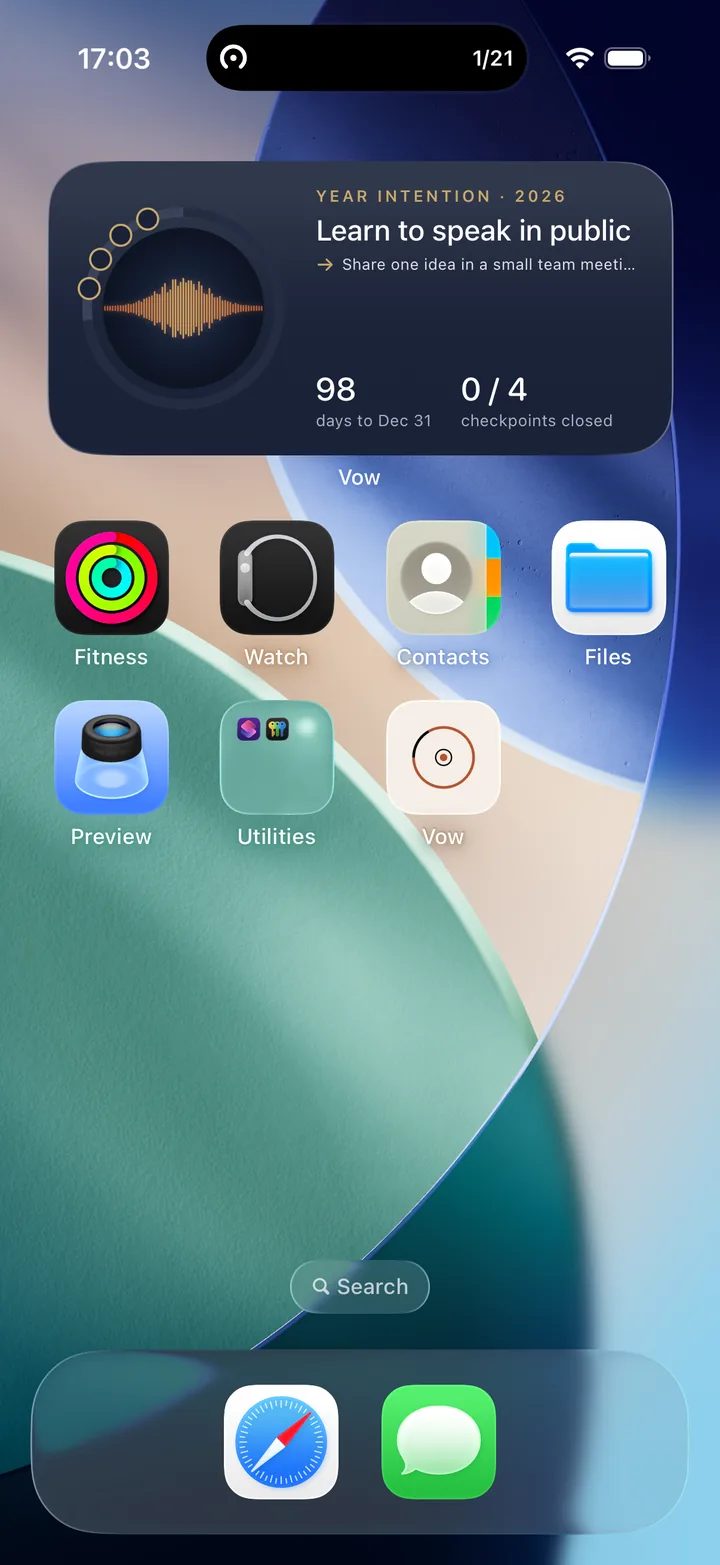
An iOS app for intentional discipline. Challenges, ascets, calendar events. No account. No subscription. Just you and your word.

Practices  ·  Discipline  ·  Stake

Vow — Askesis mode
What it is

A quiet place for serious intentions.

Vow is built around a single idea: when you say you'll do something for thirty days, the app is there for those thirty days. No streaks to brag about. No badges. No noise. Just the window, the breath, the day.

You take a vow — a habit challenge, an askesis with a stake, or a calendar event like Ramadan, Lent, or Vesak. Each day, you mark it within a window. At the end, you receive a certificate. That's the whole loop.

From inside the app

Words the product itself says.

No marketing copy. These are lines the app uses with every paying user.

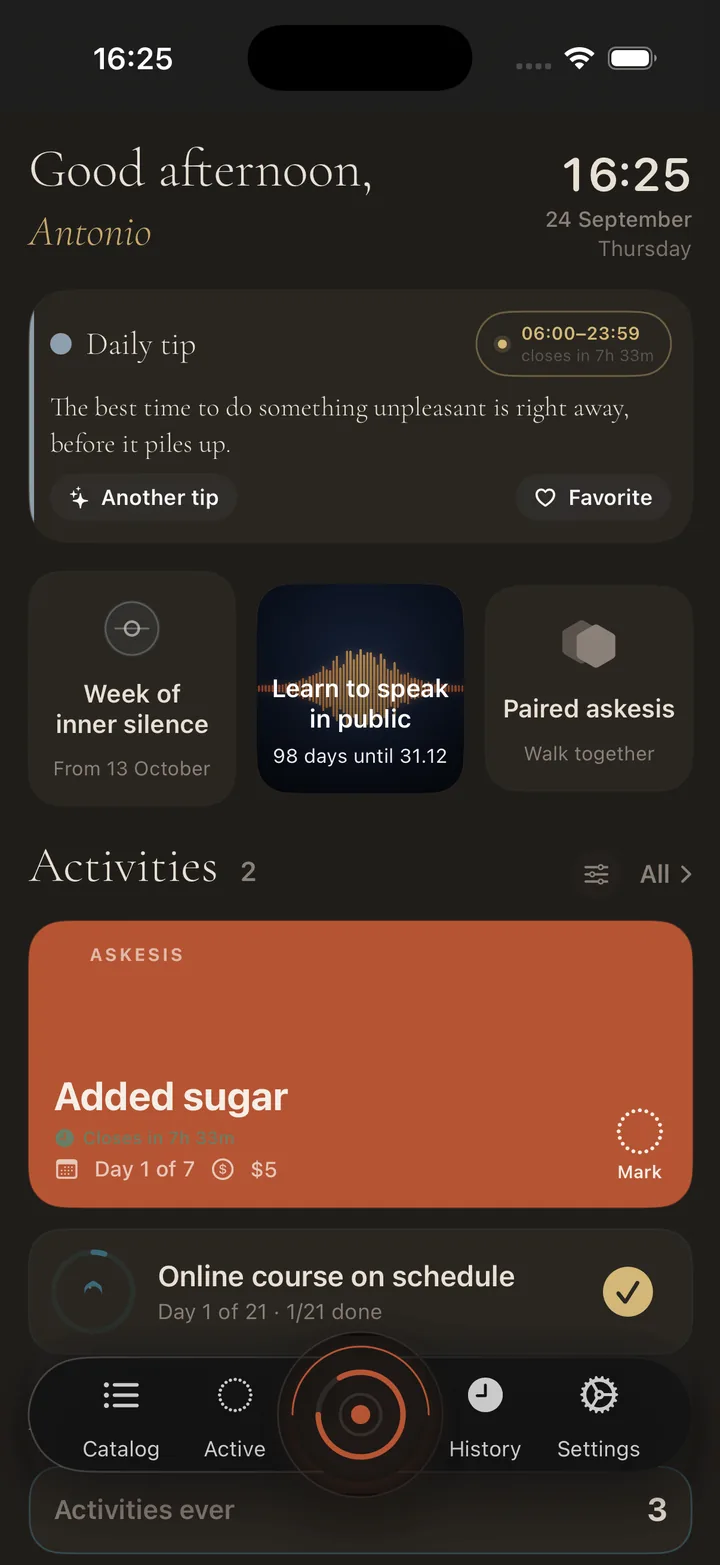
Done is better than perfect in your head.

Daily tip · home screen

Askesis only. No distractions. What matters — action.

Askesis mode · entry

Replace a complaint with an action or a fact. If neither — stay silent.

Event · Complaint fast · 10-day social askesis

Payment confirms your intention. No refunds.

Event askesis · checkout

Miss the window — the day doesn't count.

Event askesis · rules

Three commitment levels

Pick the pressure you need.

Challenge

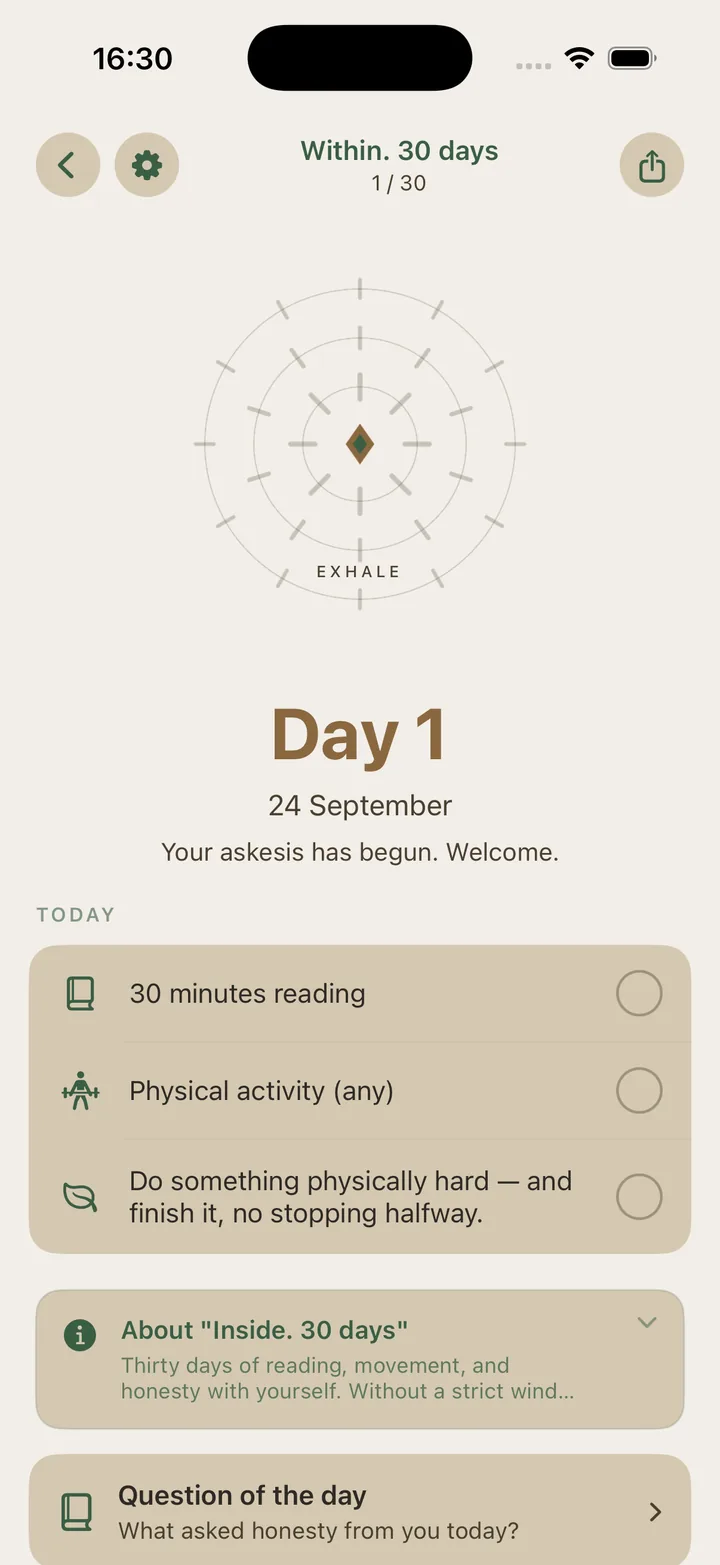
A simple daily habit — read fifteen minutes, walk eight thousand steps, no alcohol. Three difficulty tiers. No money at risk, just a streak you can break and rebuild.

Morning exercise · 14 days · 0/14 done

Askesis

A deeper commitment with a stake of one, twenty-five, forty-five, or one hundred dollars. The stake is the weight of your intention, not a deposit. Complete the period — receipt of completion. Miss a day — the stake is forfeited.

Fast food · 45 days · $45 stake

Event askesis

A practice anchored to a calendar moment — Ramadan, Lent, Vesak, Solstice, Advent, Dry January — or to a defined social discipline like a complaint fast. Fixed dates. Same stake rules. Same strict window.

Complaint fast · Jul 1 – Jul 10 · $25 stake
How a day works

A strict window. A single tap.

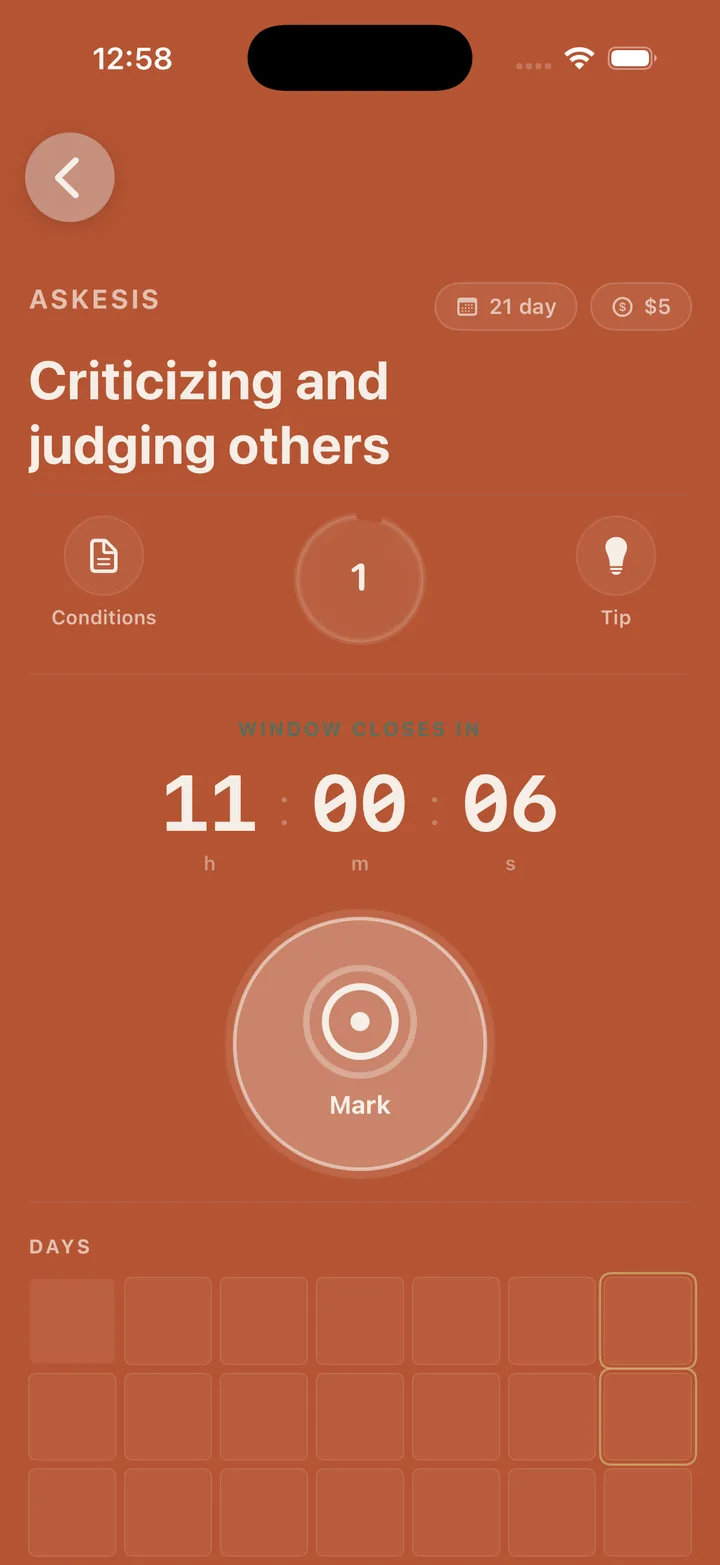
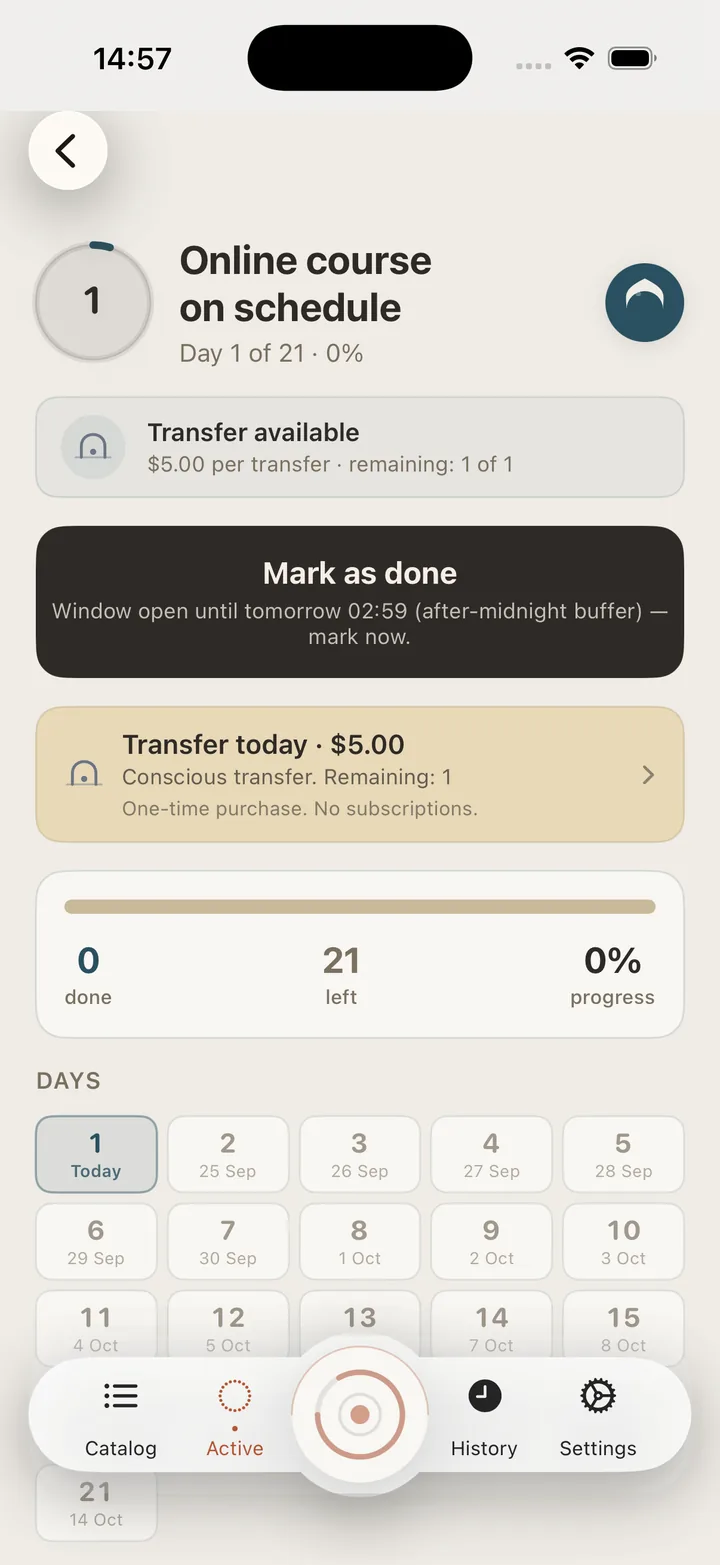
Every day has a check-in window. You can mark inside it. Outside it, the day doesn't count. The diary does not replace the check-in.

06:00
Window opens

The app shows today's countdown. You can enter Askesis mode anytime.

During the day
You do the practice

Or you don't. First and last, you are honest with yourself. The app does not verify on your behalf — it holds the window and counts the days.

Before 23:59
You tap Mark

One tap, one haptic, one day added to the dot grid. A gold ring at every seventh day. No screenshots, no proof — the contract is with yourself.

Window closes
Missed it?

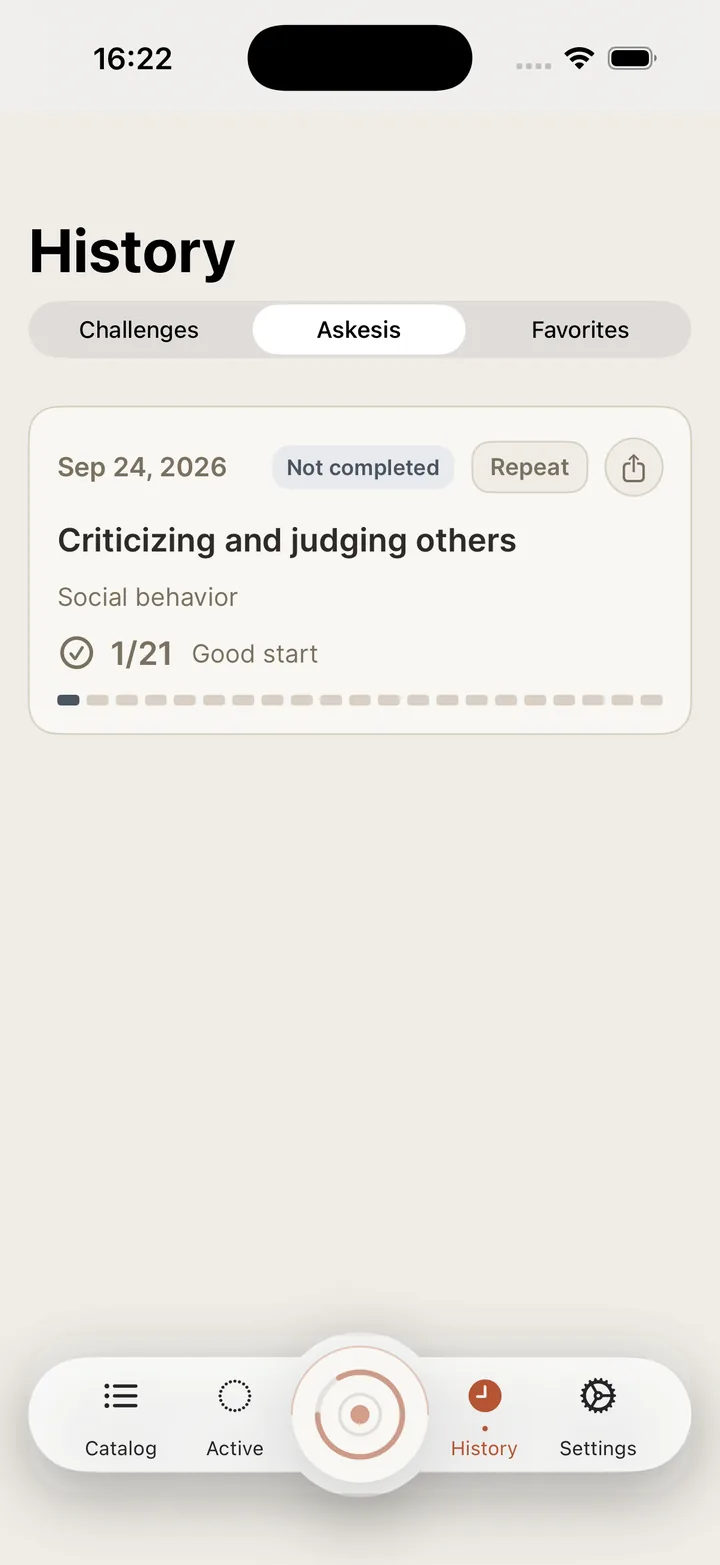
For a free challenge — broken streak, no consequence beyond honesty. For an askesis with stake — the day is missed and the askesis is not completed. No retroactive marks. No exceptions.

Events have their own windows — Ramadan after iftar, Vesak at dawn, Lent in the morning. Each event states its window before you commit.

Inside the practice

Four screens. The whole loop.

No feed. Notifications only when they matter: window opens, window closing. No reminders for the sake of it. Just the practice, the window, and today.

Askesis mode splash

Enter the mode

One screen. One discipline. Everything else stays outside.

Askesis mode focus

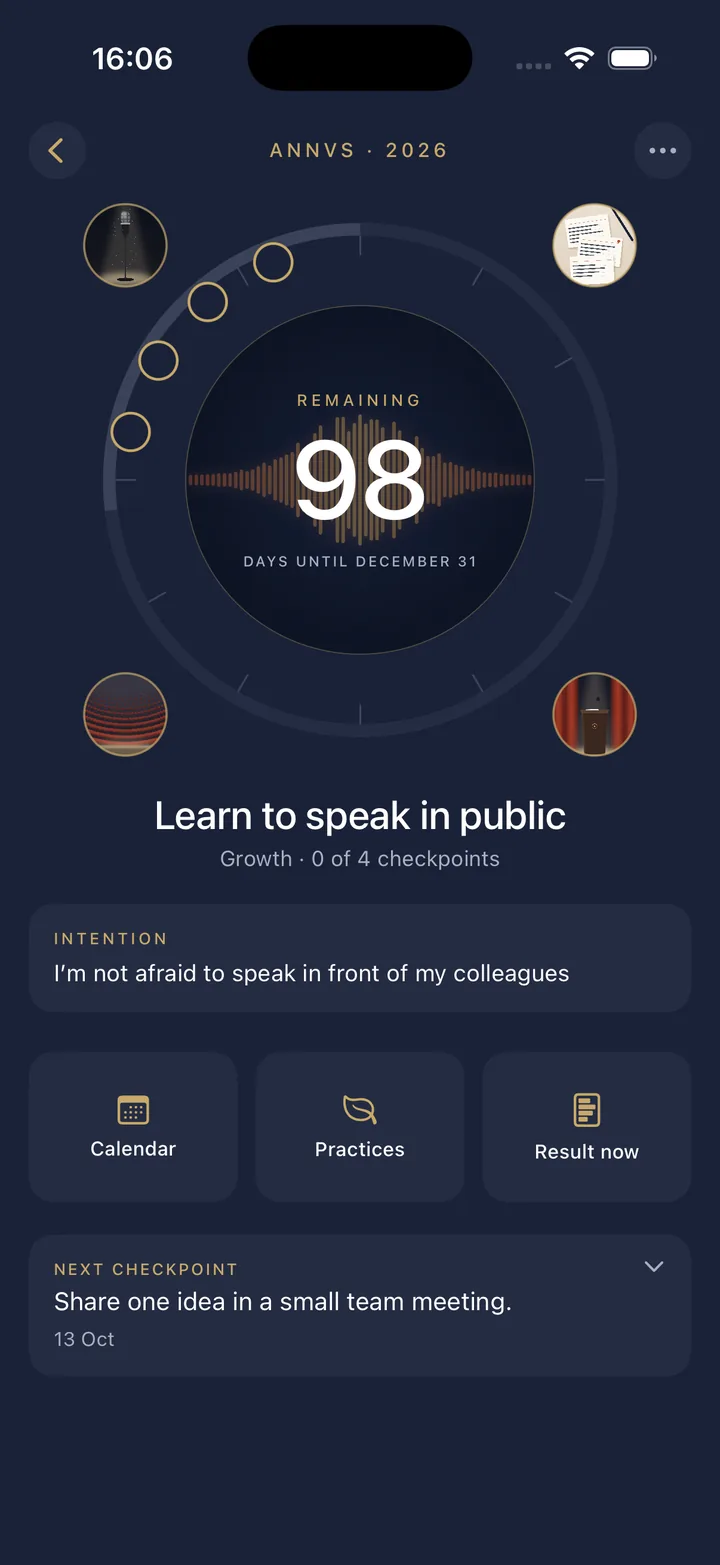
Today and the days

The check-in window. Breath cadence. The Mark button. That's it.

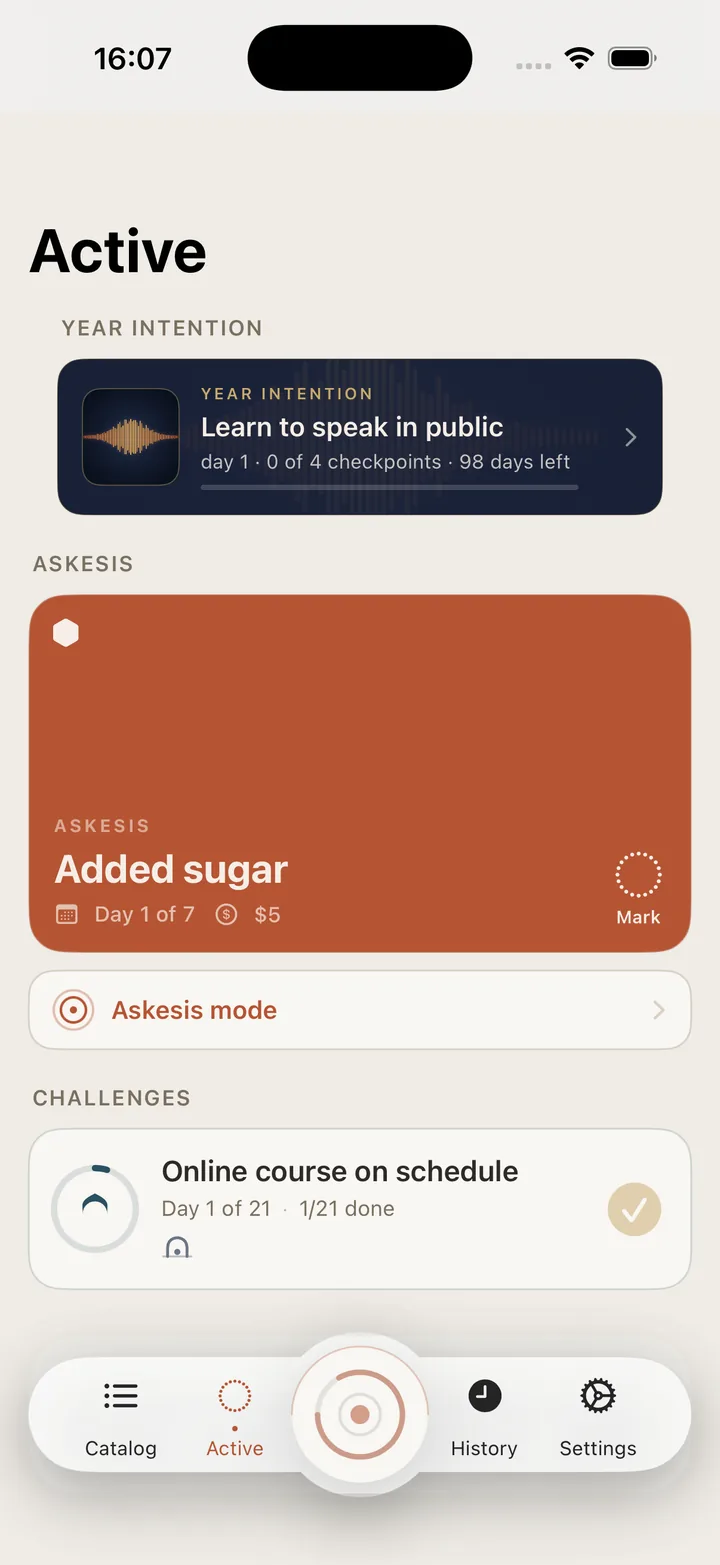
Active commitments

What you committed to

One askesis. One challenge. One planned event. No more.

Event askesis list

Joint events

Cultural anchors. Fixed dates. Same rules for everyone in the room.

What's inside

Curated, not crowd-sourced.

Every challenge, askesis, event, and practice is written by one hand. No automatic user-generated content. The catalog is the product. There is a "Suggest an event" form inside the app — we read every suggestion. Accepted ideas join the catalog no more than once per quarter, at the team's discretion.

Written by a practicing lawyer and author of a non-fiction book on legal architecture.

Catalog formation rules — public version (PDF)

75
Challenges
99
Ascets
15
Events
43
Diary practices
4
Languages
Calendar events

Practices the world already keeps.

Each event in Vow has its own emblem, color palette, breathing practice, marking window, and final scene. The visual respects the tradition — no stock religious imagery, no clichés.

Feb 18 – Mar 19

Ramadan

30 days. Marking after iftar.

Feb 23 – Apr 11

Great Lent

47 days. Morning window. Phased progression.

May 11 – 17

Vesak

7 days of non-attachment. Dawn window.

Nov 30 – Dec 24

Advent

25 days, 4 weeks. Evening candle.

What's different

Five things Vow does not do.

01

No account, no registration

Open the app and start. We don't ask for your email, phone, or name. Your data lives on your device, not on our server. On entry we ask only for age — this opens the right catalog for you: under 13, the app gently declines; 13–17, a free version without askesis and payments; 18+, the full catalog.

02

No subscription

Vow is for people tired of paying every month. Pay for a vow when you take it. That's it. Cancel nothing afterward.

03

No surveillance

The app does not watch you in any form. Not your data, not whether you actually keep the conditions of your askesis in real life. No Mixpanel, Amplitude, Firebase Analytics or any other SDKs. The app trusts you — because it trusts your honesty with yourself.

04

No gamification

No badges, no leaderboards, no competition with others. A streak belongs to you, not to an audience. A vow is a vow, not a game. We respect the seriousness of the practice.

05

No ads

Advertising — never. We do not sell your attention to a third party and we do not insert banners. Partnership events are possible: a joint askesis with a brand or cultural institution, with its own visual world and the same rules of window and completion. That is part of the catalog, not an ad.

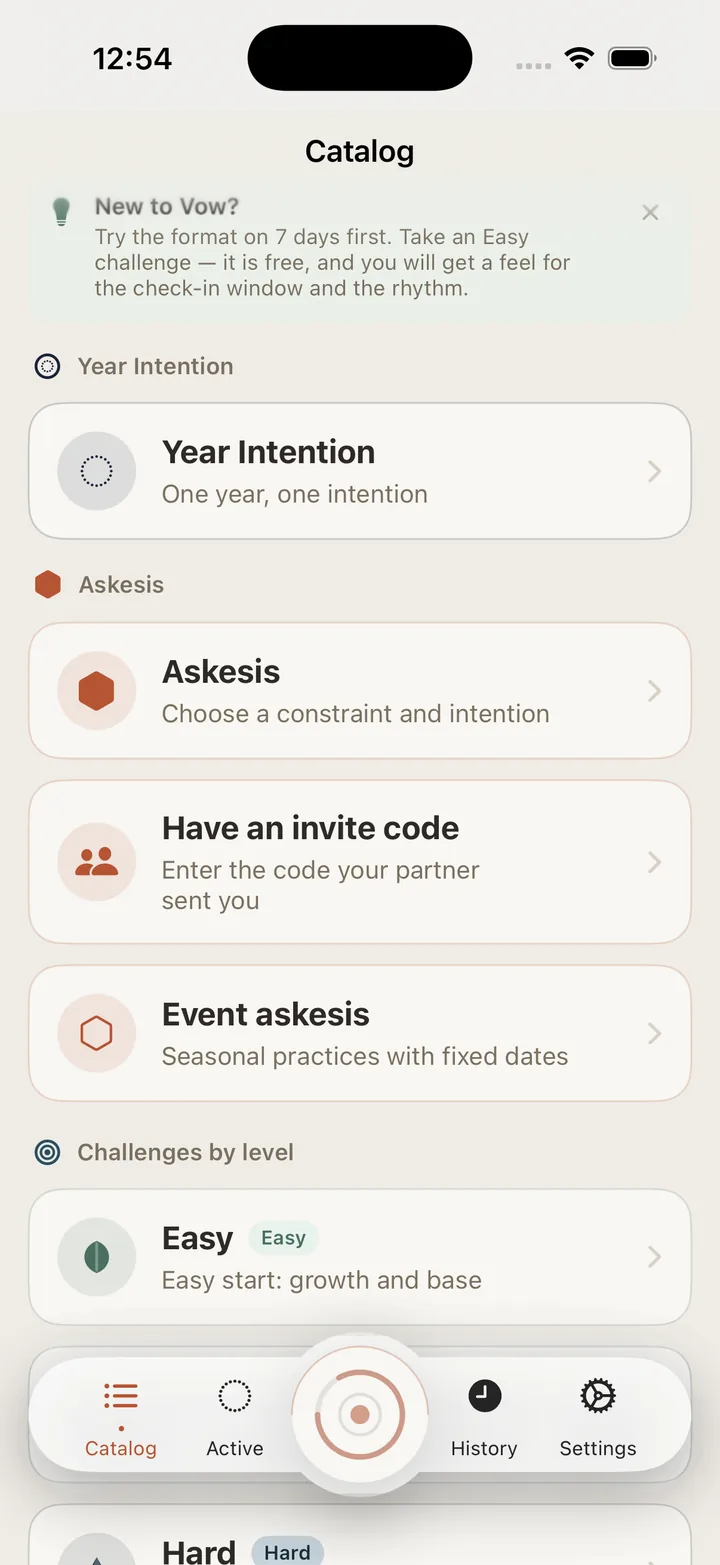
Vow catalog
Looking for 300 first users

If you'll use it honestly,
we'd love your eyes.

Vow is on TestFlight. We're looking for 300 first users across four languages — roughly 75 per language. Enough to learn what works and what we have not yet refined. 90 seconds to apply. 7 days of trying. One short feedback form after.

Apply to the beta
iOS 17 or newer · TestFlight required
Questions

Things people ask.

What is a stake, exactly?

When you start an ascet, you choose a stake of one, twenty-five, forty-five, or one hundred dollars. This is not a deposit — it doesn't come back when you finish. It's the weight you put on your intention, paid up front. The price of a serious vow.

What if I miss a day?

Challenges have a marking window each day. If you miss it, you can either skip the day (free in the easy tier, paid in higher tiers) or end the challenge early. Ascets are stricter — missing a day ends the ascet without success. This is the design.

Can I do a vow with a friend?

Yes. Paired ascets let two people commit to the same vow together. You share a code, both walk the same days, and exchange a small haptic ping when you're each present. No shared score, no chat — just synchronicity.

Is Vow for teenagers?

Vow has a separate branch for ages 13–17 with simplified, free habit challenges and event versions. No ascets, no stakes, no paid skips. Anyone under 13 receives a gentle decline at sign-in.

Will there be an Android version?

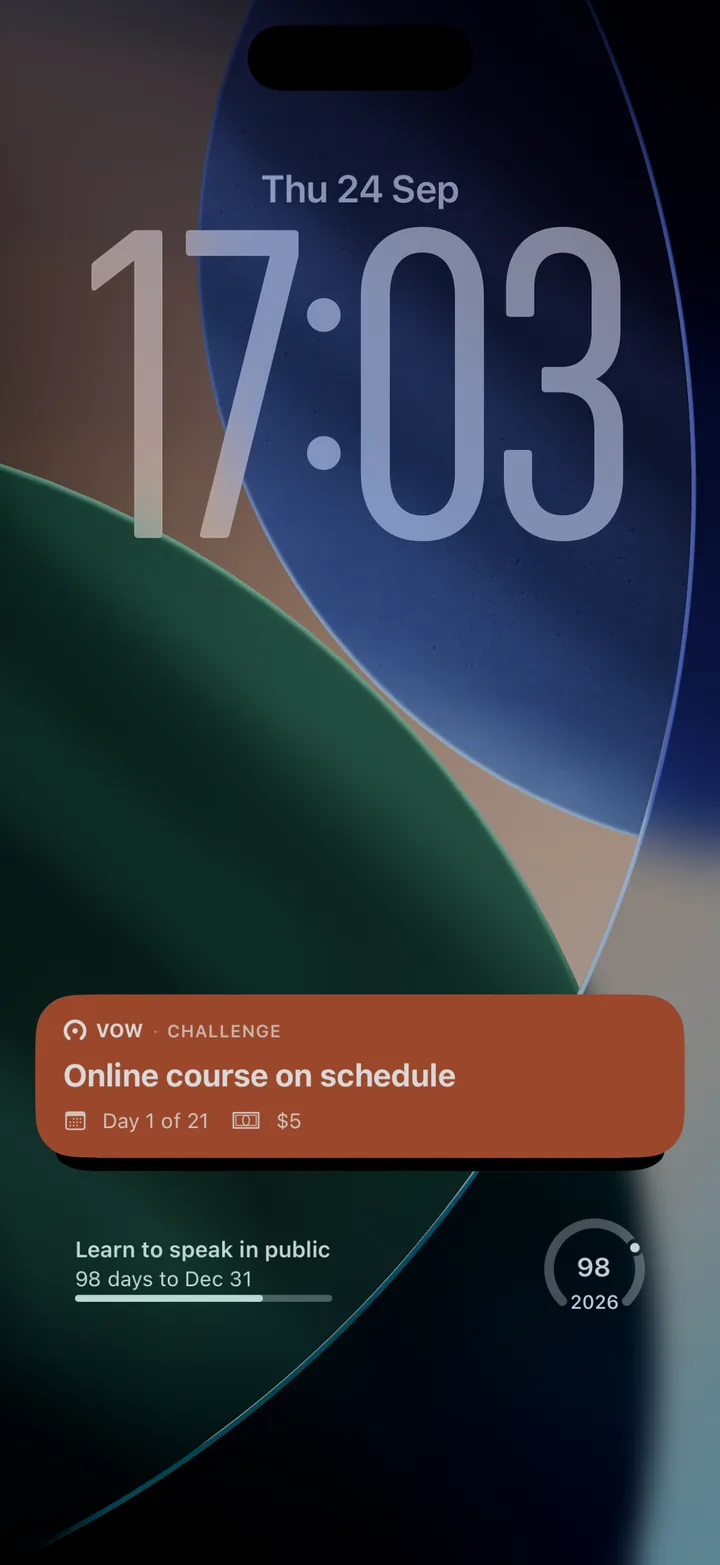
Not in 2026. The product is built specifically for iOS — Live Activities, Widgets, Dynamic Island. Android is a possible future, not a near plan.